pg-catalog-almanac
Did you know: PG19 is on track to contain the most changes to pg_catalog in history
Introduction
pg_catalog is one of the most important interfaces PostgreSQL gives us: it exposes the metadata that describes database structure – tables, columns, indexes, constraints, types, and dependencies – alongside views into what the server is doing right now. When diagnosing replication lag, long-running or blocked queries, idle transactions, lock contention, vacuum activity, and other real-time performance problems, pg_catalog is often where I’m spending my time poking around.
Every so often, working with those catalogs leads me to a question that sounds like it should have a quick answer:
I wonder when that changed.
When was leader_pid added to pg_stat_activity? Has pg_locks always had waitstart? Which catalogs and views will be new in PostgreSQL 19?
Those answers are available in the PostgreSQL documentation, tracking changes over time isn’t very trivial. Opening the documentation for several releases, comparing tables, and then checking release notes to understand what happened – this can get tedious very quickly.
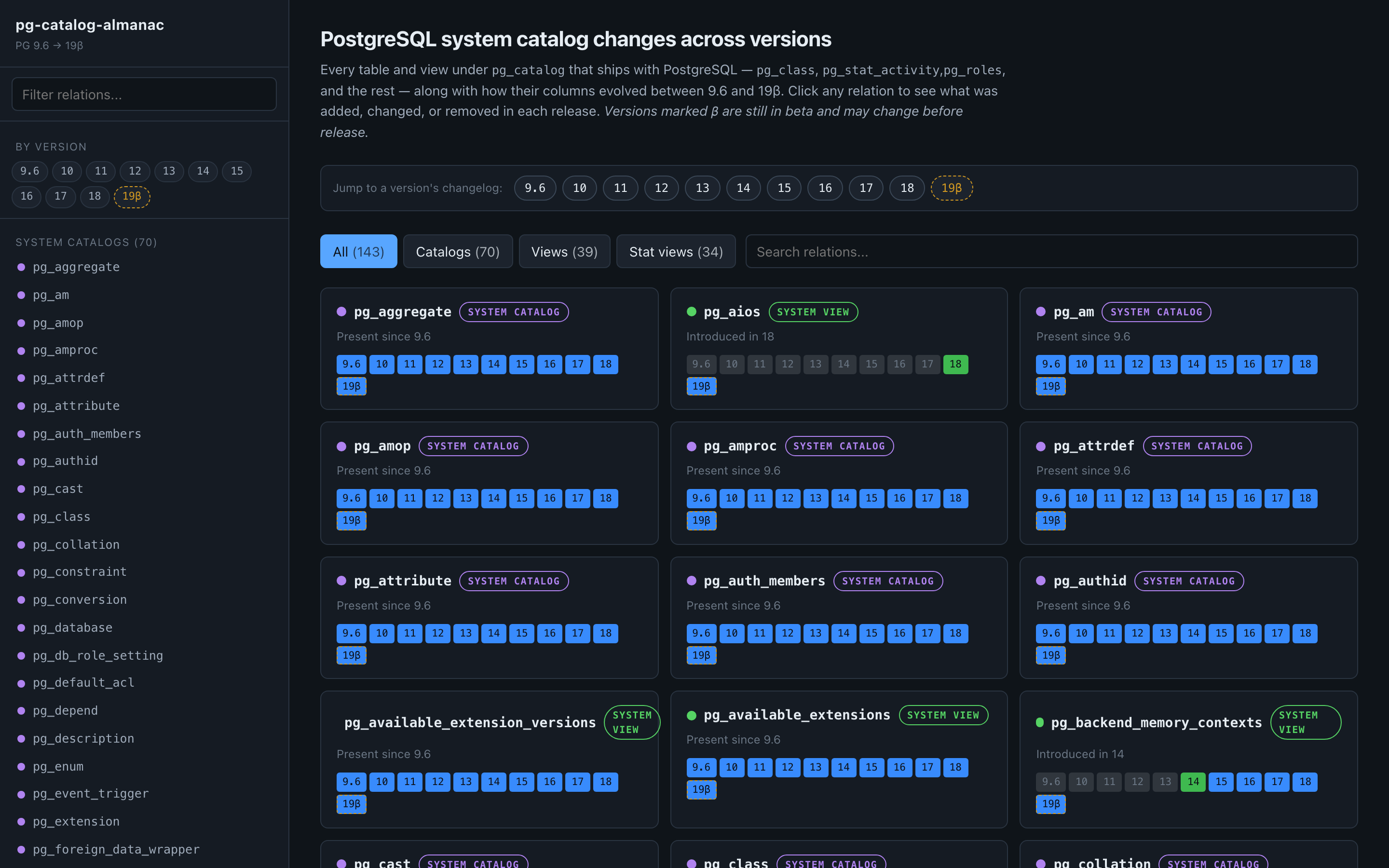
I wanted something simpler, and pg-catalog-almanac, a browsable representation of the PostgreSQL documentation for pg_catalog hopefully accomplishes that.
Inspiration
postgresqlco.nf is my favorite PostgreSQL reference outside of the official documentation. It makes the history of configuration parameters easy to explore: choose a setting, see the versions, and quickly understand how it evolved. And then there are useful links to articles as well.
I wanted that same experience for PostgreSQL’s system catalogs, system views, and statistics views. pg-catalog-almanac may not be as feature-rich as postgresqlco.nf but I hope it gets close – it currently covers all 143 documented relations across PostgreSQL 9.6 through the upcoming PostgreSQL 19.
Some Interesting Discoveries
Once I got the versions placed next to each other, I found these observations to be somewhat interesting. Might not be interesting to others, but it got my attention!
1. PostgreSQL 19 Has the Most New Relations in the Dataset
As of PostgreSQL 19 beta 3, the upcoming release adds 12 catalogs and views and 43 columns. That is the largest number of new relations in any release after the PostgreSQL 9.6 baseline. PostgreSQL 10 is the next closest with 11.
Five of the new catalogs support SQL property graphs: pg_propgraph_element, pg_propgraph_element_label, pg_propgraph_label, pg_propgraph_label_property, and pg_propgraph_property.
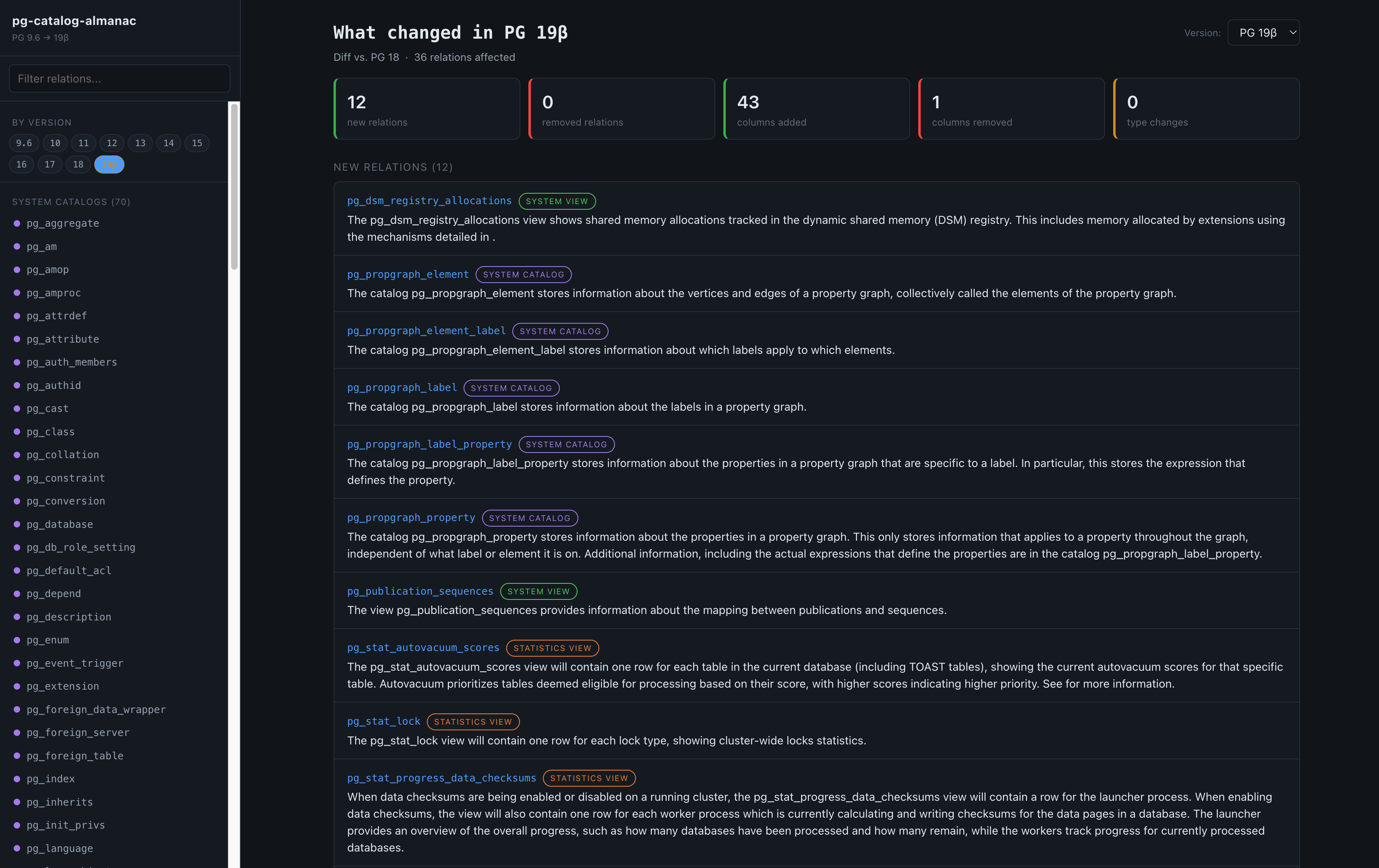
There are also several operationally interesting additions: pg_stat_lock, pg_stat_recovery, and pg_stat_autovacuum_scores, along with progress views for REPACK and online data checksum changes. At a glance, PostgreSQL 19 looks like a significant expansion in both SQL features and operational visibility.
2. Only One Entire Relation Has Ever Been Removed
Across all tracked transitions from PostgreSQL 9.6 through 19, only one relation disappears completely: pg_pltemplate.
It is present through PostgreSQL 12 and gone in PostgreSQL 13. pg_pltemplate held template information used when creating procedural languages. PostgreSQL 13 introduced trusted extensions and moved procedural-language installation onto the normal extension machinery, removing the need for that special catalog.
3. Collation Metadata Shows an Abstraction Evolving
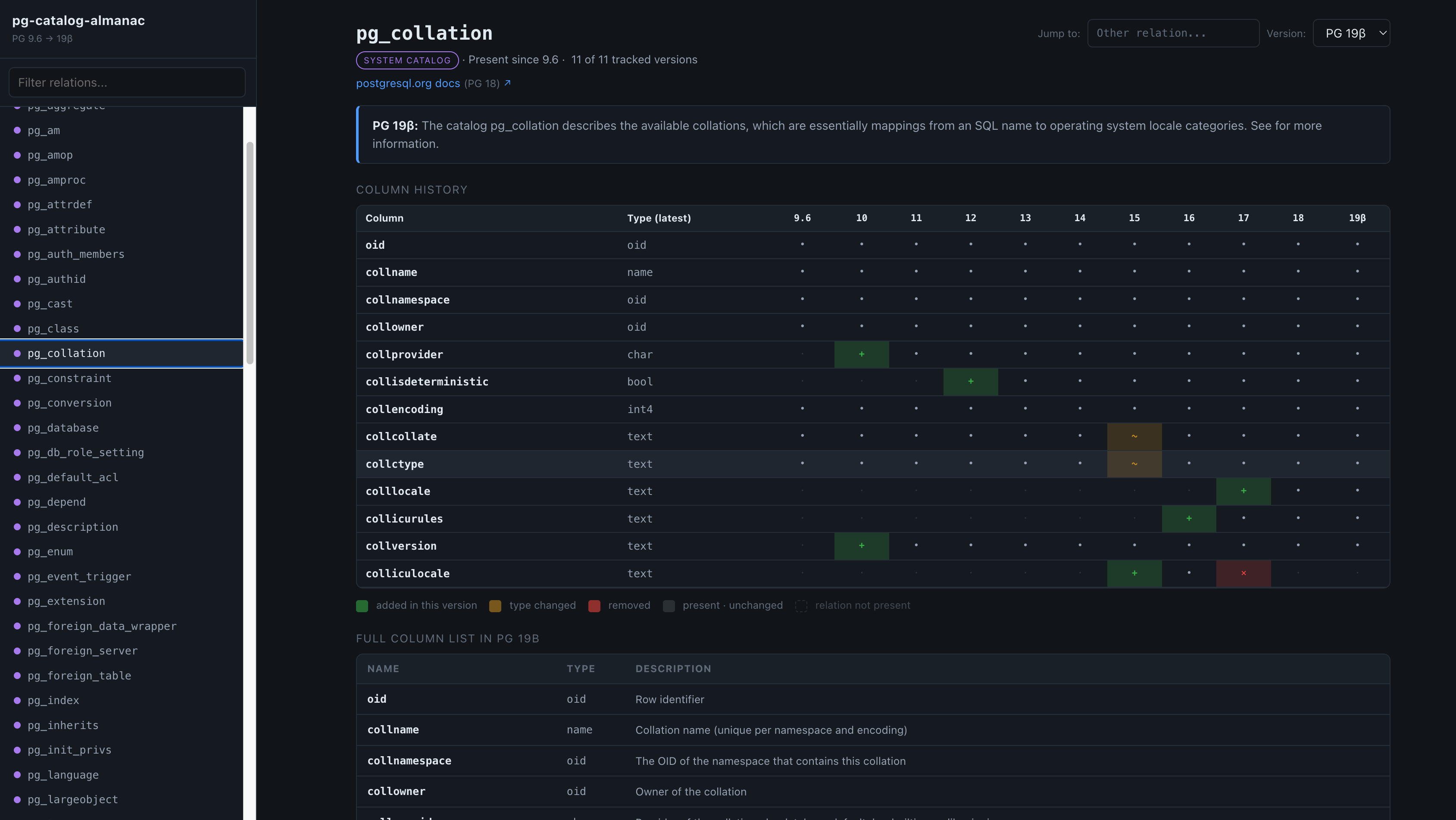
The histories of pg_collation and pg_database capture PostgreSQL’s expanding collation support through a handful of small catalog changes.
In PostgreSQL 15, pg_collation.collcollate, pg_collation.collctype, pg_database.datcollate, and pg_database.datctype changed from name to text. Locale values are not identifiers, and text permits customized ICU locale names longer than the 63-byte identifier limit while also saving space for typical short locale names.
Then PostgreSQL 17 added a built-in, platform-independent collation provider. The ICU-specific colliculocale and daticulocale names became the provider-neutral colllocale and datlocale.
Conclusion
While my main motivation was to document and understand upcoming and past changes to pg_catalog for some of my projects, I can see this being useful for DBREs and software engineers who are planning upgrades and need to tweak monitoring queries, ORMs, APIs, and so on. I hope that people can find it useful, making some aspects of DB-related research less tedious and time-consuming